USMCA certificate of origin: what it is and how to fill it out
A USMCA certificate of origin is a certification that goods qualify as originating under the United States-Mexico-Canada Agreement, which lets the importer claim preferential (reduced or zero) duty. There is no required official form: the importer, exporter or producer can put the nine minimum data elements on an invoice or any other document, and it can cover one shipment or identical goods for up to 12 months.
Key takeaways
- There is no official USMCA form: the nine data elements and the certification statement can go on an invoice or any document.
- The importer, exporter or producer can certify; a distributor that is none of these cannot sign.
- A blanket certification covers identical goods for up to 12 months, and CBP accepts a certification for four years.
- For US imports, no certification is needed for commercial shipments of originating goods worth US $2,500 or less.
- Importers and certifiers must keep the certification and supporting origin records for at least five years.
What is a USMCA form?
The USMCA (United States-Mexico-Canada Agreement) replaced NAFTA on July 1, 2020. Canada calls it CUSMA and Mexico calls it T-MEC, but it is the same agreement. Goods that meet its rules of origin can enter the United States, Mexico or Canada at a preferential duty rate, often zero.
To claim that rate, the importer needs a certification of origin. People still call it the "USMCA form" or "USMCA certificate," but unlike NAFTA, the agreement does not prescribe a template. According to U.S. Customs and Border Protection (CBP), the old NAFTA Certificate of Origin, CBP Form 434, is not accepted for USMCA claims.
Instead, the certification can appear on an invoice or any other document, as long as it contains nine minimum data elements and the required certification statement. CBP notes one exception: it should not be on an invoice or commercial document issued in a non-USMCA country. It can also be completed, signed and submitted electronically.
Because there is no standard form, you will see many layouts. Large buyers often send suppliers their own template, and a certification on a supplier's letterhead is just as valid as one on a carrier's form, provided all nine elements and the statement are there.
"Made in" is not the same as "originating"
One of the most common misunderstandings is that anything made in the United States, Mexico or Canada automatically qualifies. It does not. A good is originating only if it meets one of the USMCA origin criteria, and for most manufactured goods that means meeting the product-specific rule for its tariff classification.
For example, a product assembled in Mexico from imported parts may be marked "Made in Mexico" yet fail the USMCA rule if the assembly does not cause the required change in tariff classification or reach the required regional value content. The reverse also happens: goods can qualify for USMCA preference while still being treated as another country's product for other purposes. CBP applies separate origin rules for country of origin marking and for trade remedies such as Section 301 duties on Chinese goods, so a USMCA claim does not automatically remove those duties.
USMCA preference only applies to goods traded among the three countries. If you import from a country outside the agreement, such as Indonesia or China, a USMCA certification does not apply. A shipment from those countries may still need a different, non-preferential certificate of origin if the buyer or another trade program asks for one.
Who fills out the USMCA certificate of origin?
Under the USMCA, the certification can be completed by the importer, the exporter or the producer of the good. This is a major change from NAFTA, where only the exporter or producer could sign.
Each certifier needs a sound basis for the claim. A producer or importer must have information, including documents, showing the good is originating. An exporter that is not the producer can rely either on its own information or on the producer's written representation, such as the producer's own certification.
The agreement does not let a country require an exporter or producer to complete a certification for someone else. If your supplier will not provide one, the importer can certify, but only with enough supporting documentation to prove origin.
A U.S. distributor that only resells goods often asks whether it can sign. CBP's answer is no: only the producer, exporter or importer may complete a certification of origin. A distributor that is also the exporter of record for a shipment can certify as the exporter, but it needs supporting information or the producer's written representation to do so.
The nine minimum data elements
Annex 5-A of the agreement lists the information every certification must include. CBP's implementing instructions describe each element as follows.
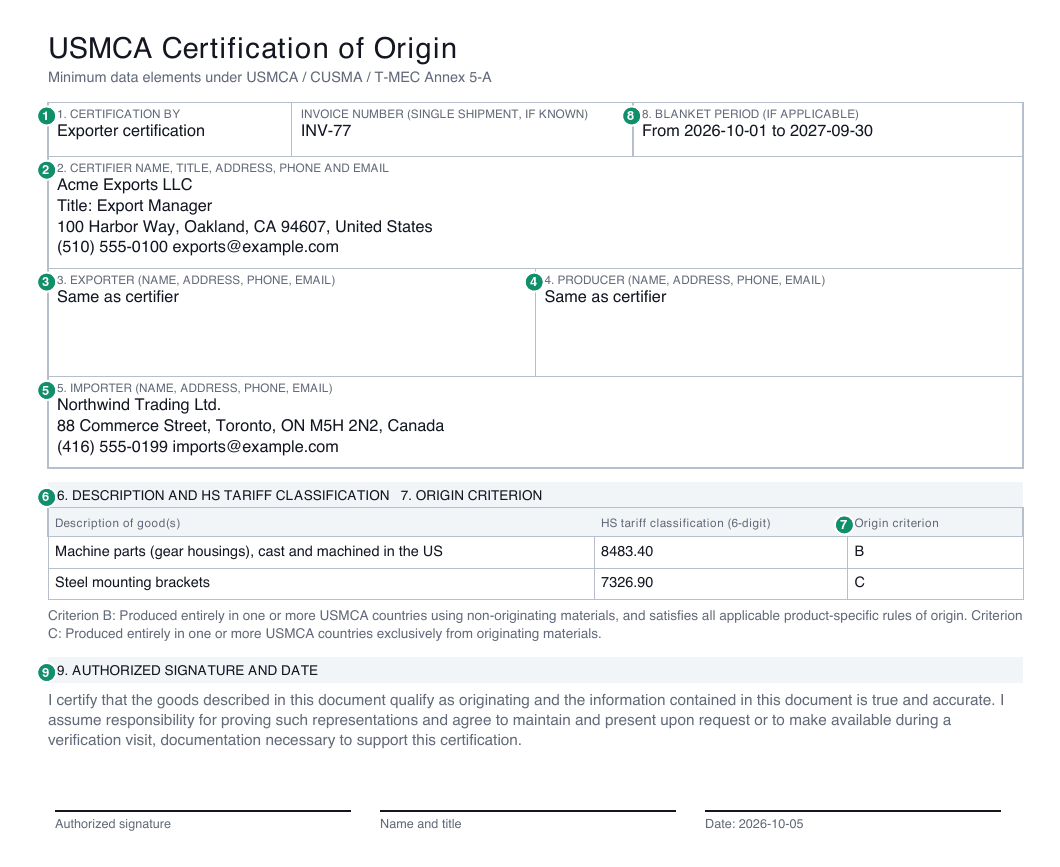
A sample USMCA certification of origin made with the free generator, with the nine minimum data elements numbered.
- Certification by: whether the importer, exporter or producer is certifying.
- Certifier: name, title, address, phone and email.
- Exporter: name, address, phone and email, if different from the certifier.
- Producer: details, or Various, or Available upon request by the importing authorities.
- Importer: name, address, phone and email, if known.
- Description and HS classification: each good with its tariff classification to six digits.
- Origin criterion: A, B, C or D for each good.
- Blanket period: the dates covered when one certification applies to repeat shipments, up to 12 months.
- Authorized signature and date: with the certification statement.
| No. | Data element | What to enter |
|---|---|---|
| 1 | Importer, exporter or producer certification | State which of the three roles the certifier holds. |
| 2 | Certifier | Name, title, address (including country), telephone number and email address. |
| 3 | Exporter | Name, address (including country), email and phone, if different from the certifier. A producer that does not know the exporter can leave this out. The address is the place of export in a USMCA country. |
| 4 | Producer | Name, address, email and phone if different from the certifier or exporter. You may write "Various" or list several producers, or state "Available upon request by the importing authorities" to keep it confidential. |
| 5 | Importer | Name, address, email and phone, if known. The address must be in a USMCA country. |
| 6 | Description and HS tariff classification | A description detailed enough to tie the certification to the goods, the Harmonized System (HS) classification to the 6-digit level and, for a single shipment, the invoice number if known. |
| 7 | Origin criteria | The criterion (A, B, C or D) under which each good qualifies. |
| 8 | Blanket period | The covered dates, if the certification applies to multiple shipments of identical goods for up to 12 months. |
| 9 | Authorized signature and date | Signed and dated by the certifier or its authorized agent, with the signer's contact details if different from the certifier. |
Origin criteria A to D in plain words
Element 7 asks which rule makes the good originating. CBP summarizes four criteria, and the good must also meet all other applicable requirements.
Some templates add fields that are not among the nine elements, such as "method of qualification" or the method used to calculate regional value content (transaction value or net cost). If you are not sure what such a field asks for, ask whoever supplied the template. The minimum requirement is the origin criterion itself, plus the facts and records that back it up.
| Criterion | When it applies | Key condition |
|---|---|---|
| A | The good is wholly obtained or produced entirely in one or more USMCA countries. | Examples include crops grown or minerals mined there. |
| B | The good is produced entirely in one or more USMCA countries using non-originating materials. | It meets the product-specific rule of origin for its tariff classification (for example, a required tariff shift or regional value content). |
| C | The good is produced entirely in one or more USMCA countries exclusively from originating materials. | All materials must be originating. |
| D | A limited rule for goods produced entirely in USMCA countries that are classified with their materials or that meet the "unassembled goods" rule. | Regional value content of at least 60 percent under the transaction value method or 50 percent under the net cost method; does not apply to textile goods in HTSUS chapters 61 to 63. |
Single shipment or blanket period
A certification can cover a single shipment, or multiple shipments of identical goods within a period stated on the certification. That blanket period cannot be longer than 12 months.
Separately, CBP must accept a certification for four years after the date it was completed. In practice, many companies issue a fresh blanket certification each year and keep the supporting records for each one.
A blanket certification works well for repeat shipments of the same products to the same customer. If a product's bill of materials or suppliers change during the period, check that the good still qualifies. A blanket certification only covers identical goods, so a new model or a new material may need its own certification.
How to fill out a USMCA certificate of origin
Because there is no official form, you can use a simple template, a section on your commercial invoice or a dedicated document. PaperPorter's free USMCA certificate of origin generator produces a certification with the required data elements in your browser, leaves the signature line blank and uploads nothing.
- Confirm the good qualifies: Find its HS classification and the product-specific rule in the agreement, and check the rule against your bill of materials.
- Choose the certifier: Decide whether the importer, exporter or producer will certify, and gather the documents that support origin.
- Fill in the parties: Enter certifier, exporter, producer and importer details, using the confidentiality or "Various" options for the producer where needed.
- Describe each good: Add a clear description, the 6-digit HS code and the origin criterion for every line.
- Set the scope: Enter the invoice number for a single shipment, or a blanket period of up to 12 months for repeat shipments of identical goods.
- Add the certification statement, sign and date: Include the statement that the goods qualify as originating and the information is true and accurate, then sign by hand or electronically.
Language, low-value shipments and recordkeeping
For U.S. imports, CBP says the certification may be in English, Spanish or French. If it is in Spanish or French, an English translation should also be provided to CBP.
CBP does not require a certification for a non-commercial importation, or for a commercial importation where the value of the originating goods does not exceed US $2,500, unless the shipment is part of a series arranged to avoid the certification rules. Mexico and Canada set their own thresholds, so check with their customs authorities for exports.
An importer claiming USMCA preference must keep records for at least five years from the date of entry, including the certification and documents supporting origin. Exporters and producers that certify must keep origin records, such as material purchases, costs and production records, for at least five years as well.
Shipping parcels and small orders across the border
Online sellers and small manufacturers often ship USMCA goods by express carrier or post rather than through a freight forwarder. The certification still matters, but how it reaches customs depends on the channel. With express carriers, the carrier usually acts as the customs broker, so the origin statement must be on or attached to the commercial invoice or saved in the carrier's system before the shipment crosses.
If the carrier's broker never sees the certification, the entry may be filed without a USMCA claim and duty may be charged. That is one of the most common reasons a buyer gets an unexpected duty bill on goods that should have qualified. Brokerage, disbursement and processing fees are separate from duty and may apply even when the USMCA claim succeeds.
Carriers and postal services do not all handle preference claims the same way, and tariff measures announced since 2025 have changed several times. Before you promise customers duty-free delivery, ask your carrier how it files USMCA claims for your shipping service and check current CBP guidance for the destination.
Questions people actually ask about USMCA certification
I make the goods and ship them to customers in another USMCA country. Am I also the importer? Usually not, because the importer is the buyer or the party bringing the goods into the destination country. The importer element only asks for details "if known," and CBP accepts "Various" in the importer field when the producer or exporter is the certifier. For exports, also check the destination country's customs guidance.
My goods are sewn or assembled here from imported fabric or parts. Do they qualify? It depends on the product-specific rule for the finished good's tariff classification. Apparel rules are among the strictest in the agreement, and decorating an imported finished garment, such as adding embroidery to a shirt, generally does not change its classification, so it is unlikely to qualify on that basis alone.
My supplier sent a certification with the package, but the carrier still billed me duty. Why? Usually either the certification never reached whoever filed the entry, so the goods were entered without a USMCA claim, or the charge was an additional tariff that a USMCA claim does not remove. Ask the carrier which charge was applied and whether the entry claimed USMCA, then compare that with CBP's current guidance for the measure involved.
Does USMCA protect goods from the new tariffs on Canada and Mexico? It depends on the tariff. CBP's guidance on the IEEPA duties said that, from March 7, 2025, goods from Canada or Mexico that qualify for USMCA preference are not subject to those additional IEEPA tariffs. Other measures, such as Section 232 duties on autos and auto parts, apply under their own rules. These measures have changed several times, so check CBP's current notices before you rely on a USMCA claim to avoid them.
We have been claiming USMCA for years without any certifications on file. What now? That is a serious problem. CBP requires the importer to have a valid certification in its possession when the claim is made, and CBP can ask for it on any entry within the recordkeeping period. Talk to a licensed customs broker or trade attorney about correcting past entries rather than asking a supplier to produce backdated documents.
I paid duty on goods that qualified. Can I get it back? Often yes. Under CBP regulations, an importer that did not claim USMCA at entry can file a post-importation claim for a refund within one year after the date of importation, under 19 U.S.C. 1520(d), with a copy of the certification and the other statements CBP requires. CBP's FAQ adds that a missed USMCA claim cannot be added later through a post summary correction; the 1520(d) claim is the route.
The manufacturer told me in a message that the product qualifies. Is that enough? An informal message is not a certification, because it lacks the data elements and the certification statement. For a non-commercial importation into the United States, such as a personal gift, CBP does not require a certification, but the carrier may still ask for origin details to file the entry.
Do I need a certification for a small order? For U.S. imports, not when the originating goods are worth US $2,500 or less, unless the shipment is one of a series arranged to avoid the rules. Without a certification, the preference still has to be claimed on the entry, so tell your carrier or broker that the goods qualify. Canada and Mexico set their own low-value thresholds.
Can I resell used goods made in a USMCA country under a USMCA claim? Only if someone who can certify has information showing the good is originating. A reseller that is the exporter can rely on the producer's written representation, but used goods often lack that paper trail, which makes certifying difficult.
Our customer insists on its own USMCA template. Do we have to use it? No format is required, so your own certification is valid if it contains all nine elements and the statement. Many suppliers fill in the customer's template anyway to keep the relationship simple.
If I switch to a manufacturer in Canada or Mexico, will my products qualify? Not automatically. The goods still have to meet the USMCA rule of origin for their tariff classification, so a stationery maker in Canada that uses imported paper or parts may or may not qualify. Ask the producer whether the specific products are originating and whether it will provide a certification, or the written representation an exporter can rely on.
Common mistakes to avoid
Most problems come from treating the certification as a formality. CBP can deny the preference claim if the goods do not qualify, and if a blanket certification is found wrong, it can affect every entry made under it.
- Assuming "Made in USA" or "Made in Mexico" means the good qualifies, without checking the product-specific rule.
- Using the old NAFTA CBP Form 434, which is no longer accepted.
- Certifying without supporting documents, especially when the importer certifies on a supplier's word alone.
- Letting a distributor or sales agent sign when it is not the importer, exporter or producer.
- Listing an HS code at the wrong level or one that does not match the product description, or entering a code in a carrier's system that does not match the invoice.
- Writing a blanket period longer than 12 months, or using one certification for goods that are not identical.
- Keeping the certification in a sales file where the carrier or customs broker never sees it, so the entry is filed without a USMCA claim.
- Promising customers that a USMCA claim removes every tariff, when some additional duties apply to qualifying goods anyway.
- Leaving out the certification statement, the signature or the date.
- Claiming the wrong origin criterion, for example criterion C when some materials are non-originating.
- Throwing away bills of materials and supplier records before the five-year recordkeeping period ends.
Fixing errors in a certification
Mistakes happen. CBP will not reject a certification only because of minor errors, and an importer asked to fix one gets at least five working days to supply a corrected copy.
If a U.S. exporter or producer learns that a certification it gave for goods exported to Canada or Mexico is based on incorrect information, CBP regulations require it to promptly notify, in writing, everyone it gave the certification to, and to notify CBP. Importers that discover an invalid claim should talk to their customs broker about correcting the entry.
Where to check the official rules
This guide summarizes CBP's published guidance and is not legal advice. Rules of origin are product-specific and can be technical, so for complex goods such as vehicles, auto parts or textiles, read the CBP USMCA pages and consider working with a licensed customs broker.
Want to understand the other documents that travel with a USMCA shipment? Our guides to the bill of lading and common shipping terms cover them.
Related articles
What is a bill of lading?
What is a bill of lading? Learn its three functions, straight vs order BOLs, who fills it out, and key fields like consignee, PRO number, SCAC, NMFC and HM.
Read →Proforma invoice vs commercial invoice: what is the difference?
Proforma invoice meaning, how it differs from a commercial invoice and a quote, when customs accepts a proforma, and what to include on each document.
Read →What does FOB mean in shipping?
What does FOB mean in shipping? FOB under Incoterms 2020 vs US FOB origin and destination, plus how EXW, FCA, CIF, DAP, DDP and other terms split risk and cost.
Read →Last updated 2026-10-05. General information, not legal or customs advice. Check current rules with the relevant agency or carrier.
Frequently asked questions
Is there an official USMCA certificate of origin form?
No. The USMCA does not prescribe a form, so any format is acceptable if it includes the nine minimum data elements and the certification statement. CBP does not accept the old NAFTA CBP Form 434.
Who can fill out a USMCA certificate of origin?
The importer, the exporter or the producer of the good can complete it. Whoever certifies must have information showing the good is originating, or, for an exporter that is not the producer, may rely on the producer's written representation.
How long is a USMCA certificate of origin valid?
A certification must be accepted for four years after the date it was completed. A blanket certification can cover identical goods shipped within a stated period of up to 12 months.
Do I need a USMCA certificate for low-value shipments?
For U.S. imports, CBP does not require one for non-commercial importations or commercial importations where the originating goods are worth US $2,500 or less, unless the shipment is part of a series meant to evade the rules.
Can I get a refund if I forgot to claim USMCA?
For U.S. imports, the importer can file a post-importation claim under 19 U.S.C. 1520(d) within one year after the date of importation, with a copy of the certification of origin and the statements CBP requires.
Does "Made in USA" mean a product qualifies for USMCA?
Not necessarily. A good qualifies only if it meets a USMCA origin criterion, usually the product-specific rule for its tariff classification, and the certifier must have records to prove it.