
Proforma invoice vs commercial invoice: what is the difference?
A proforma invoice is a preliminary bill sent before a sale is final or goods ship, telling the buyer what they will be charged. A commercial invoice is the final bill for goods actually sold and shipped, and it is the main document customs uses to value and classify imports. The proforma is an estimate; the commercial invoice is the record of the real transaction.
Key takeaways
- A proforma invoice is a preliminary bill sent before the sale is final or goods ship; it is a good faith estimate.
- A commercial invoice is the final bill for goods sold and shipped, and customs uses it to value and classify imports.
- A proforma is generally not recorded as a sale or receivable and usually does not support sales tax or VAT records.
- A proforma can stand in for customs in specific cases, such as non-sale shipments, but rules vary by country and carrier.
- Always declare a truthful, realistic value; undervaluing goods or calling a sale a gift can lead to penalties and seizure.
What is a proforma invoice?
"Pro forma" is Latin for "as a matter of form." A proforma invoice (also written pro forma invoice) is a document a seller sends to a buyer in advance, showing the goods, quantities, prices and terms the seller expects to invoice once the order is confirmed and shipped.
Buyers use proformas to get internal purchase approval, arrange payment in advance, apply for an import license or open a letter of credit with their bank. Sellers use them to lock in the details of an order before committing production or shipping space.
A proforma is a good faith estimate. It is not a demand for payment in the accounting sense, so a seller generally does not record it as a sale or an account receivable, and the buyer does not record it as a payable.
Do not confuse a proforma invoice with pro forma financial statements. In accounting, "pro forma" figures are projected or adjusted numbers, such as a forecast income statement. A proforma invoice is a trade document about one specific order.
What is a commercial invoice?
A commercial invoice is the final bill of sale between the seller (exporter) and buyer (importer) for goods that are being shipped. It records what was actually sold, at what price, on what terms, and it is the basis for payment and for the seller's accounting.
In international trade, the commercial invoice is also a customs document. Customs authorities use it to determine the value of the goods, classify them and assess duties and taxes. That is why it must describe the goods accurately and match the bill of lading and packing list.
For goods entering the United States, federal regulations list information a commercial invoice must contain. It includes the port of entry, the parties and details of the sale, a detailed description of the merchandise, quantities, the price paid or value and its currency, itemized charges such as freight, insurance and packing, the country of origin, and any assists (items like molds or tooling the buyer supplied). Other countries set their own requirements, so check the destination's customs authority.
US rules also require the invoice and its attachments to be in English or to come with an accurate English translation. If your supplier issues invoices in another language, ask for a bilingual version before the goods ship rather than after they arrive.
Proforma invoice vs commercial invoice: side by side
The two documents often look almost identical, which is why they get confused. The differences are in timing, purpose and legal weight.
| Aspect | Proforma invoice | Commercial invoice |
|---|---|---|
| Timing | Issued before the sale is final or before shipment | Issued when the goods ship |
| Purpose | Confirms intended terms; supports approvals, prepayment and financing | Bills the buyer and supports customs clearance |
| Accounting status | Generally not recorded as a sale or receivable | The record of the completed transaction |
| Changes | Can be revised if quantities, prices or shipping costs change | Should reflect the final agreed figures |
| Customs use | Accepted only in specific situations, which vary by country and carrier | The standard document for entry |
| Labeling | Clearly marked "Proforma Invoice" so no one mistakes it for a final bill | The final bill of sale |
When is each one issued?
A typical export order moves through several documents. Knowing where each fits helps you avoid sending the wrong one.
- The buyer asks for pricing, and the seller replies with a quote.
- The buyer accepts or places a purchase order, and the seller sends a proforma invoice confirming the terms.
- The buyer pays a deposit, gets approvals or opens a letter of credit based on the proforma.
- The seller ships and issues the commercial invoice, along with a packing list and the bill of lading.
- The importer or its customs broker uses the commercial invoice to clear the goods at the destination.
Pro forma invoice vs quote
A quote (or quotation) is an offer: it tells a prospective buyer what the seller would charge, and it often has an expiry date. It may be short and informal, and the buyer has not committed to anything.
A proforma invoice usually comes after the buyer has shown clear intent to buy. It is more detailed than a quote and is laid out like an invoice, with full party details, product descriptions, unit prices, totals, Incoterms, payment terms and estimated shipping information.
In practice, some sellers use a proforma as a formal quote, especially in export sales. What matters is that both parties understand whether the document is an offer, a confirmation of an order, or the final bill.
Can a proforma invoice be used for customs?
Sometimes. A proforma invoice can stand in for a commercial invoice in certain cases, but the rules depend on the destination country and, for express parcels, on the carrier.
A common case is a non-sale shipment, such as free samples, warranty replacements, goods returned for repair or items sent between offices of the same company. There is no sale price, so the shipper prepares a proforma that states a value for customs purposes and explains why no payment is involved. Many express carriers accept a proforma for these shipments, but check your carrier's requirements.
For US imports, CBP regulations allow entry on a pro forma invoice when the required commercial invoice is not available at the time of entry. The importer must give a bond for the missing invoice, and the regulations set the amount at one and one-half times the invoice value. The commercial invoice then generally must be produced within 120 days after the entry summary is filed. Your customs broker can tell you whether this applies to your shipment.
US rules also exempt some shipments from needing a commercial invoice at all, such as goods not intended for sale or any commercial use. Even then, the importer must present whatever invoice or bill it has, and if none exists, a pro forma invoice is filed instead. So the proforma is often the right document for personal or non-sale goods, as long as it states a truthful value.
Whatever the situation, the declared value must be truthful. Undervaluing goods on any invoice presented to customs can lead to penalties, delays or seizure.
Gifts, samples, repairs and returns: what value to put on the invoice
Non-sale shipments cause more confusion than any other invoice question. The rule of thumb is that customs always needs a realistic value, even when no money changes hands. Writing "0" or "free" usually leads to questions, and customs may set a value itself.
For gifts, the shipment must really be a gift. CBP describes a duty-free allowance of $100 for bona fide gifts sent from people abroad to people in the US, and other countries set their own limits. Marking goods a buyer paid for as a "gift" to avoid duty is a false declaration, and US law imposes civil penalties for material false statements on entry documents, whether the cause is fraud or negligence.
For samples, describe exactly what the item is and state a fair value, often the cost to produce it, along with a note such as "free sample, no charge to customer." Carriers commonly reject generic descriptions like "sample" or "parts" on their own.
For repairs, warranty replacements and returns, explain the reason for export and include any original invoice or return authorization number. Some countries charge duty only on the value of the repair when goods come back, but the documentation required to claim that treatment varies, so ask your customs broker before you ship.
| Shipment | Value to state | What to include | Watch out for |
|---|---|---|---|
| Gift | A realistic value; CBP describes a $100 duty-free allowance for bona fide gifts sent from people abroad to people in the US | A clear statement that it is a gift and a specific description | Goods a buyer paid for are a sale; calling them a gift is a false declaration |
| Sample | A fair value, often the cost to produce it | An exact description and a note such as "free sample, no charge to customer" | Carriers commonly reject generic descriptions like "sample" or "parts" |
| Repair, warranty replacement or return | A realistic value, never "0" or "free" | The reason for export and any original invoice or return authorization number | Duty treatment on return varies by country, so ask your customs broker first |
- State a realistic value and the currency for every item.
- Give the reason for export: gift, sample, repair, warranty replacement or return.
- Describe each item specifically, including material and use.
- Mark the document clearly as a proforma invoice when no sale took place.
- Keep proof of the value, such as a receipt or cost record.
Paying against a proforma invoice safely
Paying a deposit against a proforma is normal in international trade, especially with a new supplier. The proforma is what the buyer's bank or finance team sees when it approves a wire transfer or opens a letter of credit.
The main risk is fraud, not the document itself. A common scheme is a fake or altered proforma that looks identical to the real one but lists different bank details, often sent from a hacked or look-alike email address with a story about a changed bank account.
Before you pay, confirm that the beneficiary name on the proforma matches the supplier's registered company name, and verify any new or changed bank details by phone or video with a contact you already know, not one listed in the same email. If anything changes after you pay, such as quantities or freight costs, ask for a revised proforma so the final commercial invoice has a clear paper trail.
What to include on a proforma invoice
A useful proforma gives the buyer and its bank everything they need to approve and pay. Include the items below and label the document clearly.
- The words "Proforma Invoice," a reference number and date of issue
- Seller and buyer names, addresses and contact details
- Description of each item, quantity, unit price and line totals
- Currency, estimated freight and insurance charges, and the total
- Incoterms rule and named place, such as FOB or FCA with a port or city
- Payment terms, such as advance payment or letter of credit
- Estimated shipping date, method and validity period of the offer
- Country of origin and HS code (Harmonized System tariff number) if known
What to include on a commercial invoice
A commercial invoice should let customs value and classify the goods without guessing. Use the final figures, and make sure every detail matches your other shipping documents.
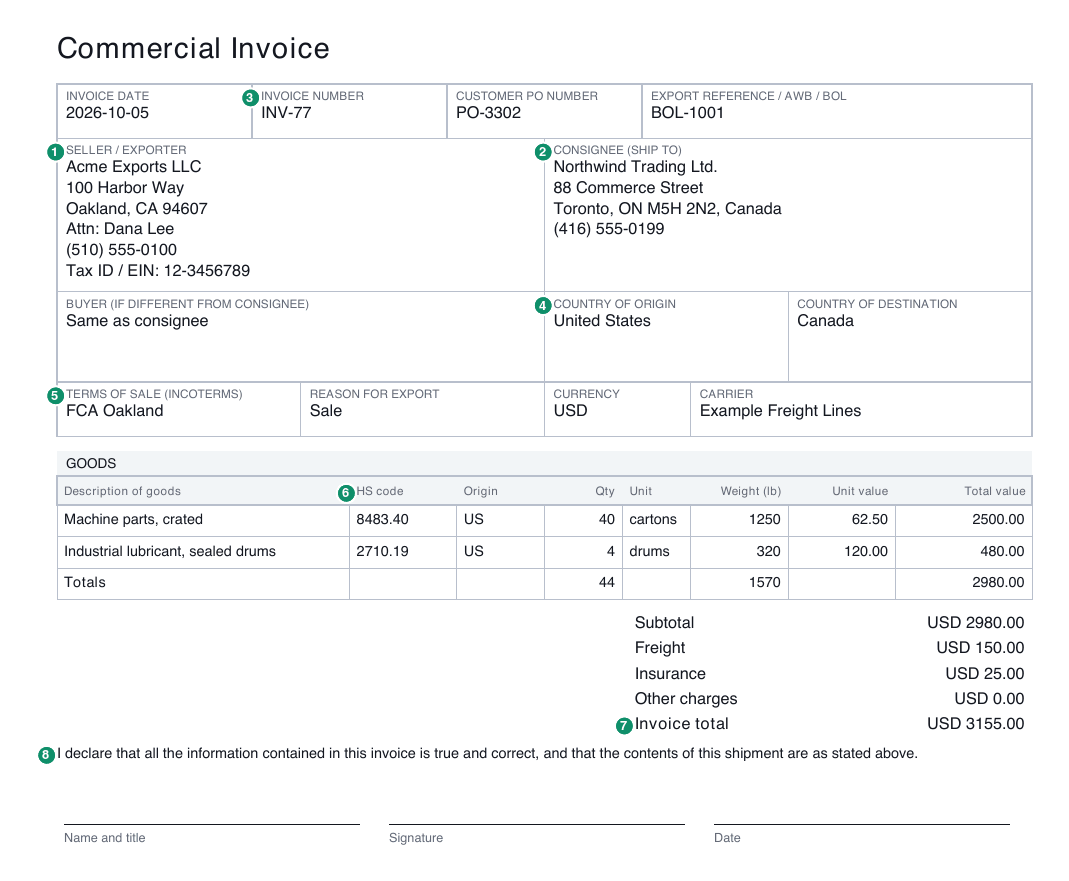
A sample commercial invoice made with the free commercial invoice generator. Customs uses these fields to value and classify the goods.
- Seller or exporter: name, address and tax ID of the party selling the goods.
- Consignee: who the goods are shipped to, plus the buyer if different.
- Invoice number and date: the references that tie the invoice to the packing list and bill of lading.
- Country of origin and destination: where the goods were made and where they are going.
- Terms of sale: the Incoterms rule and named place, for example FCA Oakland.
- HS code: the tariff classification of each line, which drives duty rates.
- Values and totals: unit and total value per line, then freight, insurance and the invoice total in one currency.
- Declaration and signature: the statement that the invoice is true and correct, signed by the seller.
- Invoice number and date, plus any purchase order number
- Exporter, importer and, if different, the consignee and sold-to party
- Detailed description of goods, quantities and units of measure
- Unit price, total value and currency
- Itemized charges such as freight, insurance, packing and commissions
- Incoterms rule and named place
- Country of origin, HS codes, and package count, weights and marks
- Reason for export, such as sale, sample or repair, when shipping without a sale
Questions people actually ask about proforma and commercial invoices
These are the questions small importers, online sellers and first-time exporters ask most often. When the honest answer is that it depends, the answer says what it depends on.
- My supplier sent a proforma. Can I give that to my customs broker? Usually you need the final commercial invoice. A US entry can be made on a pro forma when the commercial invoice is unavailable, but that requires a bond and producing the real invoice later.
- A marketplace or brand rejected my proforma as proof of purchase. Why? A proforma shows what a seller intends to charge, not a completed purchase, so platforms and brands that verify your supply chain often ask for a final invoice from the manufacturer, distributor or supplier and refuse proformas, quotes, order confirmations and store receipts. Before you pay a new supplier, ask whether it can issue a proper final invoice in your business name, and check the platform's stated document rules.
- What invoice should I ask my supplier for if I arrange the shipping myself? Ask for a commercial invoice with the final quantities and prices, your business as the buyer, the Incoterms rule (for example EXW or FOB with a named place), the country of origin and a specific description of each item. Ask for a matching packing list at the same time so weights and carton counts agree.
- My supplier put my personal name on the commercial invoice instead of my business name. Does it matter? It can. US rules require the invoice to identify the person the goods are sold to, and customs authorities and brokers expect that party to line up with the importer on the entry. A mismatch can mean questions, delays or records that do not support your business's tax and inventory books. Asking the supplier to reissue the invoice before shipping is easy; fixing it after arrival is not.
- My supplier quoted DDP. Will I get customs paperwork in my own name? Not necessarily. Under the Incoterms 2020 DDP rule the seller handles import clearance and pays duties and taxes, so the entry is often filed by the seller's forwarder, sometimes as part of a consolidated shipment, and you may receive only the commercial invoice and a freight bill. If you need proof of import for resale, VAT or audits, ask who will be importer of record and what document you will receive before you agree to DDP.
- My parcel already had a customs declaration form. Why was it held for a missing invoice? Postal customs forms such as the CN22 or CN23 are declarations, not invoices. Whether a separate commercial invoice is also needed depends on the destination country and the goods, and the postal service puts the responsibility on the sender to find out. For sales to business or overseas customers, attaching an invoice in a document pouch avoids most of these holds.
- My supplier offered to change the HS code so I pay less duty. Is that allowed? The code must describe what the product actually is. Changing the code on paper without changing the product is misclassification and can lead to penalties and back duties. Changing the product itself, such as its material, can legitimately change the classification. If you are unsure, ask a licensed customs broker, or request a binding ruling from CBP before importing.
- Why did my duty go up when the invoice and HS code stayed the same? Duty depends on the classification and the rates in effect when the goods are entered. The tariff schedule is revised periodically and additional duties can be added or changed, so the same product can cost more to import from one month to the next. Your broker can show which rate lines applied to the entry.
- Can the commercial invoice differ from the proforma? Yes. The commercial invoice should show what actually shipped and the final price. If you are paying by letter of credit, the bank checks the commercial invoice against the credit's terms, not against the proforma.
- Can I put a lower value on the invoice so my customer pays less duty? No. Undervaluing goods is a false declaration. It can lead to penalties, seizure and closer inspection of future shipments, and the buyer usually bears the consequences at import.
- Can I mark a sale as a gift? Only if it really is a gift. Goods a customer paid for are a sale, and customs rules on gift allowances apply only to genuine gifts.
- I am shipping to a fulfillment warehouse. Who goes on the invoice as the importer? A warehouse address is usually just the delivery location. You still need an importer of record who is responsible for the entry, so confirm with your broker and the warehouse program before booking.
- Does the commercial invoice need a signature? It depends on the carrier and the destination. Many express carriers and some countries ask for a signed declaration that the information is true, so check your carrier's requirements.
- What currency should the invoice use? Any currency agreed in the sale, as long as it is clearly stated. US rules require the invoice to show the currency of the price.
- Do I need HS codes on the invoice? Not every country requires them on the invoice itself, but carriers and brokers commonly ask for them, and correct codes help customs classify goods without delay.
- Is a proforma invoice a tax invoice? Generally no. It is a preliminary document, not the final bill, so it usually does not support sales tax or VAT records. Check your tax authority's rules if you need a valid tax invoice.
Common proforma and commercial invoice mistakes
Invoice mistakes rarely stop a shipment at the origin; they surface at the destination, when the goods are already waiting at the border. These are the ones that cause holds most often.
| Mistake | What goes wrong | Fix |
|---|---|---|
| Sending the proforma instead of the final invoice | The broker files numbers that no longer match what shipped | Send the commercial invoice with the final figures |
| No clear label | The buyer books it as a bill, or customs treats it as final | Mark the document "Proforma Invoice" |
| Zero or token values | Customs decides the value itself | State a realistic value and currency for every item |
| Generic descriptions | A hold for more information | Describe each item specifically, including material, use or model |
| Missing Incoterms rule | Unclear whether freight and insurance are in the price, which affects customs value | Include the rule and a named place, such as FOB or DAP |
| Totals that do not match the packing list | Questions and inspections | Make quantities and weights agree across the invoice, packing list and bill of lading |
| Wrong country of origin | Can change the duty owed | List where the goods were made, not where they shipped from |
| Arithmetic and weight errors | Every other figure looks unreliable | Check that unit price times quantity equals the line total and net weight is not above gross weight |
| Wrong buyer name | Slower clearance and muddled records | Ask the supplier to reissue the invoice in the importer's name before shipping |
| Calling a sale a gift | Penalties and seizure | Declare paid goods as a sale; gift rules apply only to genuine gifts |
Create matching shipping documents
Mismatched numbers between the invoice, packing list and bill of lading are a common cause of customs holds. Building all three from one set of details helps keep them consistent.
The free commercial invoice template, packing list template and bill of lading form share one shipment record saved only in your browser, so you enter the details once and get all three. Nothing is uploaded, and signature lines are left blank for you to sign.
To understand the terms that appear on these documents, see what FOB means in shipping and what a bill of lading is.
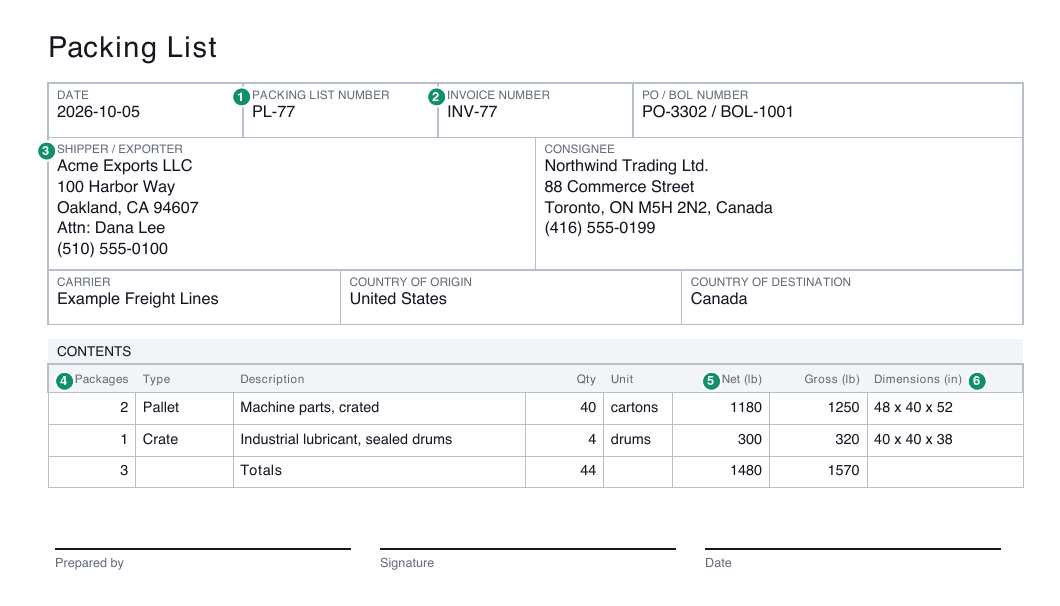
A sample packing list from the same shipment record. It describes the packages, not their value.
- Packing list number: its own reference for this shipment.
- Invoice number: matches the commercial invoice so customs and the buyer can compare the two.
- Shipper and consignee: the same parties as on the invoice and bill of lading.
- Packages: how many pallets, crates or cartons, which should match the bill of lading.
- Net and gross weight: weight of the goods alone and with packaging.
- Dimensions: size of each package, which carriers use for space and pricing.
Related articles
What is a bill of lading?
What is a bill of lading? Learn its three functions, straight vs order BOLs, who fills it out, and key fields like consignee, PRO number, SCAC, NMFC and HM.
Read →What does FOB mean in shipping?
What does FOB mean in shipping? FOB under Incoterms 2020 vs US FOB origin and destination, plus how EXW, FCA, CIF, DAP, DDP and other terms split risk and cost.
Read →Shipping terms glossary: ARO, LTL, RMA, SLI and more
Plain-English shipping terms glossary: what ARO, LTL, RMA and SLI mean, plus PRO number, SCAC, NMFC, freight class, TEU, HS code and other freight jargon.
Read →Last updated 2026-10-05. General information, not legal or customs advice. Check current rules with the relevant agency or carrier.
Frequently asked questions
What is the meaning of a proforma invoice?
A proforma invoice is a preliminary invoice sent before a sale is final or before goods ship. It shows the buyer the expected goods, prices and terms but is not a final demand for payment.
What is the difference between a proforma invoice and a commercial invoice?
A proforma is an estimate issued before shipment to confirm terms and support payment or approvals. A commercial invoice is the final bill for goods actually shipped and is the main document customs uses to assess duties.
Is a proforma invoice legally binding?
A proforma is generally treated as a good faith estimate, not a final bill. Whether its terms bind the parties depends on the contract and applicable law, so confirm the final terms in a purchase order or sales contract.
Can I pay against a proforma invoice?
Yes. Many international sellers ask for advance payment or a deposit based on the proforma, and the commercial invoice is issued when the goods ship. Verify the bank details directly with the supplier before sending money.
Can a proforma invoice be used instead of a commercial invoice for customs?
Sometimes, such as for samples or other non-sale shipments, or when the commercial invoice is not yet available. Rules vary by country and carrier, so check with your carrier or customs broker.
What value do I put on a commercial invoice for a free sample?
State a realistic value, such as the cost to produce the item, and note that it is a free sample with no charge to the customer. Customs needs a value even when nothing is paid.