What is a bill of lading?
A bill of lading (BOL or B/L) is the document a carrier issues to the shipper when it takes goods for transport. It serves as a receipt for the cargo, evidence of the contract of carriage, and, when it is a negotiable order bill, a document of title that controls who can claim the goods.
Key takeaways
- A bill of lading is the carrier's receipt for the goods, evidence of the contract of carriage and, if negotiable, a document of title.
- A straight bill names the consignee and cannot be endorsed; an order bill can be endorsed, and cargo is released only against an original.
- The carrier issues the bill, but the shipper usually prepares it and the carrier's driver or agent signs it at pickup.
- Count, inspect and write exceptions before signing at pickup or delivery; a note on the delivery receipt alone is not a claim.
- Wrong freight class, weight or hazmat details cause rebills, delays and penalties, so check the bill against the invoice and packing list.
What does bill of lading mean?
The word "lading" is an old term for loading cargo, so a bill of lading is literally a record of goods loaded for shipment. It is one of the oldest documents in trade, and it still travels with almost every freight shipment today, whether by truck, rail or ocean vessel.
In shipping, the bill of lading is the paper (or electronic record) that ties together the shipper (the party sending the goods), the carrier (the company moving them) and the consignee (the party receiving them). It describes what was handed over, where it is going and on what terms.
In the United States, federal rules for for-hire motor carriers require a receipt or bill of lading that shows, at minimum, the names of the consignor and consignee, origin and destination points, number of packages, a description of the freight, and its weight, volume or measurement when that affects the rate. Carriers usually ask for more detail than that minimum.
A simple example: a furniture maker books a pallet with a less-than-truckload (LTL) carrier. The maker fills out a bill of lading listing the pallet, its weight and the store receiving it, the driver signs it at the dock, and that signed paper becomes the record everyone refers back to if the pallet arrives late, short or damaged.
The three functions of a bill of lading
A bill of lading does three separate jobs. Understanding them explains why carriers, banks and customs brokers all care about getting it right.
- Receipt for the goods: the carrier confirms it received a stated number of packages in apparent good order. Notes about damage or shortages made at pickup are called exceptions, and a bill without them is often called a clean bill.
- Evidence of the contract of carriage: the bill records the terms under which the carrier agreed to move the goods, often by referring to the carrier's published terms, tariff or service rules.
- Document of title: a negotiable (order) bill of lading represents the goods themselves. Whoever lawfully holds the original, properly endorsed, can claim the cargo, which is why banks use order bills in letter of credit deals.
Types of bills of lading
The type you use depends on the mode of transport, whether ownership may change during transit, and who arranged the shipment. These are the types people search for most.
| Type | What it is | Typical use |
|---|---|---|
| Straight bill of lading | Non-negotiable bill naming a specific consignee; cannot be transferred by endorsement | Most domestic US truck shipments |
| Order (negotiable) bill of lading | Made out "to order" or "to the order of" a party; can be endorsed, and cargo is released only against a surrendered original | Ownership changing while goods are at sea; letter of credit deals |
| Inland bill of lading | Covers movement over land by truck or rail | Factory to port, or between two warehouses |
| Ocean bill of lading | Issued for carriage by sea; an on-board bill confirms loading on a named vessel, a received-for-shipment bill only confirms the carrier has the goods | Sea freight |
| Master bill of lading (MBL) | Issued by the actual carrier, such as an ocean line | Usually issued to a freight forwarder or consolidator |
| House bill of lading (HBL) | Issued by a forwarder or NVOCC to its own customer | Cargo consolidated under one master bill |
| Sea waybill | Receipt and evidence of the contract of carriage, but not a document of title and not negotiable | Trusted trading partners and shipments between related companies |
Bill of lading vs sea waybill
A sea waybill looks similar to an ocean bill of lading and also works as a receipt and evidence of the contract of carriage. The key difference is that a sea waybill is not a document of title and cannot be negotiated.
With a sea waybill, the carrier delivers to the named consignee without requiring an original paper document to be surrendered. That makes release faster and avoids the risk of lost originals, so it suits trusted trading partners and shipments between related companies.
When a seller wants to keep control of the goods until it is paid, or when a bank is financing the deal, an original negotiable bill of lading is usually required instead.
You may also hear about a telex release (sometimes called a surrender). Here the shipper hands the original bills back to the carrier or its agent at origin, and the carrier sends a message to its office at destination authorizing release without originals. It is a common way to speed up release when an original bill has already been issued, but release practices and fees vary by carrier, so confirm the process before relying on it.
Who issues and who fills out a bill of lading?
Legally, the carrier (or its agent) issues the bill of lading, because it is the carrier's acknowledgment of receipt. In practice, the shipper or its logistics provider usually prepares the document and the carrier's driver or agent signs it at pickup.
For truck freight, many shippers fill out a standard straight bill form or generate one in their own system, print copies, and hand them to the driver. For ocean freight, the shipper or forwarder submits shipping instructions and the carrier or NVOCC drafts the bill for review before it is issued.
When a freight broker arranges the move, the broker is not the carrier. The motor carrier that actually picks up the freight is the one signing for it, so its name, and ideally its SCAC, should appear on the bill. A common source of confusion is a bill that lists the broker in the carrier box; if that happens, ask the broker which carrier is hauling and make sure the driver's company matches before you load. The same check applies to the rate confirmation: the carrier named on the bill, the carrier named on the rate confirmation and the company whose truck shows up should all be the same. If they are not, stop and verify the carrier's registration on the FMCSA website, and call the number listed there rather than one printed on the paperwork.
If you need a quick domestic bill, the free bill of lading generator builds one in your browser. It shares one shipment record with the commercial invoice template and packing list template, so you enter details once and get all three. Nothing is uploaded, and signature lines are left blank for the shipper and carrier to sign.
Key fields on a bill of lading
Layouts vary by carrier and mode, but most domestic and ocean bills include the fields below. Carrier-specific requirements override any general template, so check your carrier's instructions.
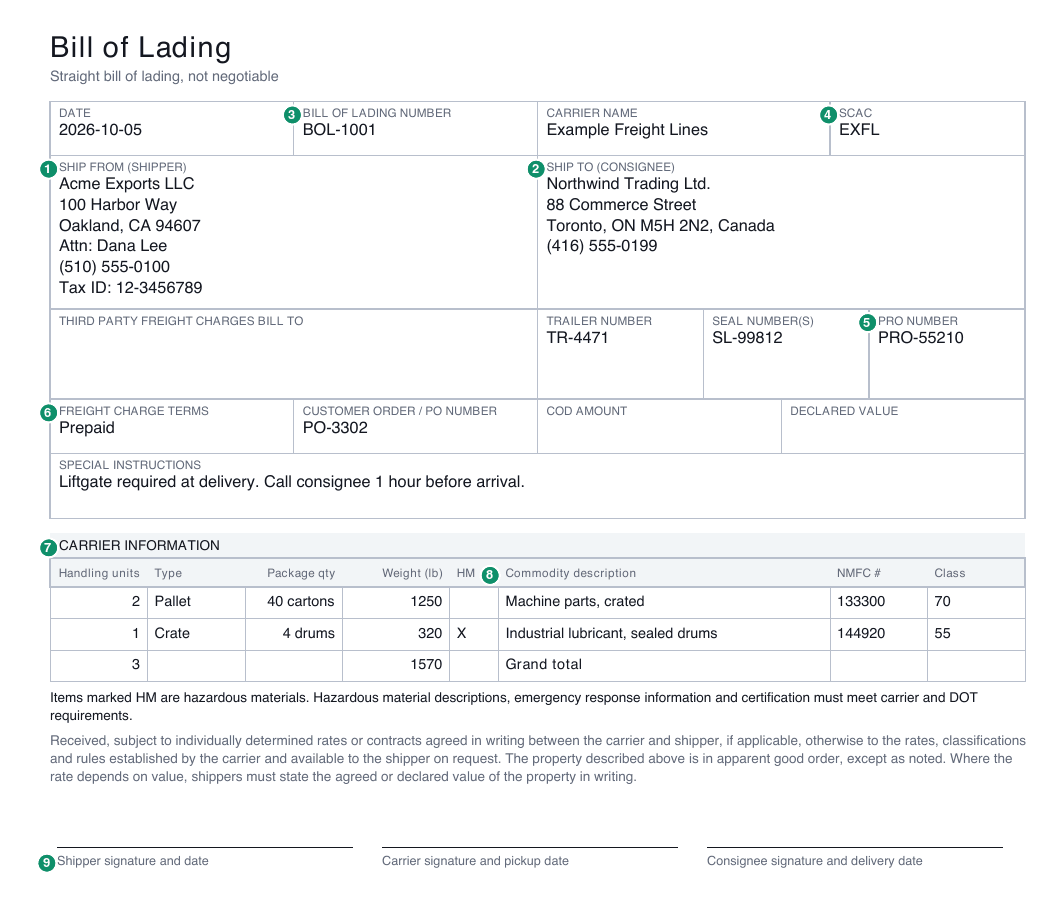
A sample straight bill of lading made with the free bill of lading generator. The numbers mark the fields carriers check most.
- Ship from (shipper): who is sending the goods, with a contact and phone for the pickup.
- Ship to (consignee): who receives the goods. On a straight bill, only this party can take delivery.
- Bill of lading number: the shipper's or carrier's reference for this shipment.
- SCAC: the carrier's Standard Carrier Alpha Code, a two to four letter identifier.
- PRO number: the carrier's tracking number for the freight, often added at pickup.
- Freight charge terms: prepaid, collect or third party, which says who pays the carrier.
- Carrier information: handling units, weight, description, NMFC item and freight class, which set the rate.
- HM: marked with an X when a line is a hazardous material, which brings extra DOT requirements.
- Signatures: shipper at pickup, carrier when it accepts the freight, consignee at delivery. Note damage or shortages before signing.
- Bill of lading number: the unique reference for this shipment, used to track it and match it to invoices and claims.
- Shipper (consignor): the name and address of the party sending the goods.
- Consignee: the party the carrier delivers to. On a straight bill this is a named company or person; on an order bill it may read "to order" or "to the order of" a bank or the shipper.
- Notify party: who the carrier contacts when the goods arrive, often the buyer or a customs broker. It is common on ocean bills.
- SCAC: the Standard Carrier Alpha Code, a two to four letter code assigned by the National Motor Freight Traffic Association that identifies the carrier.
- PRO number: a tracking number assigned by the carrier, especially less-than-truckload (LTL) carriers, often printed as a barcode label on the bill.
- NMFC item number: the National Motor Freight Classification entry that describes the commodity for LTL pricing.
- Freight class: the LTL class, from 50 to 500, based on density, handling, stowability and liability. Lower classes generally cost less to ship.
- Trailer and seal numbers: for full truckloads, the trailer number and the number on the tamper-evident seal applied after loading. The consignee checks that the seal on arrival matches the bill.
- HM column: marked with an "X" (or "RQ" for a reportable quantity) to flag hazardous materials, followed by the required hazmat shipping description and an emergency response phone number.
- Pieces, weight and description: the handling units, package count, weight and a plain description of the goods.
- Freight terms: who pays the freight charges, such as prepaid, collect or third party.
- Special instructions: delivery needs such as appointment required, liftgate or residential delivery. Carriers often bill these as accessorial (extra) charges, and leaving them off can lead to a failed delivery or a surprise invoice.
What is the consignee and the PRO number on a bill of lading?
The consignee is the receiver of the shipment. It is not always the buyer: goods can be consigned to a warehouse, a customs broker or a bank. The carrier's duty is to deliver to the consignee (or, for an order bill, to the lawful holder), so a misspelled name or wrong address can delay delivery.
The PRO number (short for progressive number) is the carrier's own tracking number. You use it to check status, request a delivery receipt and file claims. The bill of lading number is usually the shipper's reference, so many bills show both.
Shippers often mix up three numbers. The bill of lading number identifies the document, the PRO number is the carrier's tracking reference, and on ocean freight a booking number identifies the space reservation made before the bill exists. If your bill has no PRO number, the carrier usually assigns one at pickup; ask the carrier to look up the shipment using the bill of lading number, pickup date and shipper and consignee names.
Signing the bill of lading at pickup and delivery
The driver's signature at pickup confirms that the carrier received the freight as described. That is why drivers are taught to count pieces and look for visible damage before they sign, and to write any problem directly on the bill as an exception, such as "2 cartons crushed" or "received 9 of 10 pallets."
When a shipper loads and seals a trailer without the driver watching, the driver often writes "shipper load and count" (SLC) on the bill. This notation records that the carrier could not verify the count. If the seal is intact on delivery, it supports the position that any shortage did not happen in transit. It does not cover damage caused by the carrier's handling.
At delivery, the consignee signs a delivery receipt, which becomes the proof of delivery. This is the moment to count and inspect. Damage or shortages noted on the delivery receipt are much easier to support in a claim than problems reported days later, so receivers should note anything visible before the driver leaves, even if it slows the unload.
- Count handling units and compare them with the bill before signing.
- Check that the seal number on the trailer matches the seal number on the bill.
- Write exceptions on every copy, not just the copy you keep.
- Take dated photos of damaged packaging and pallets.
- Keep your signed copy; the carrier will ask for it if there is a claim.
Lost, short or damaged freight: how the bill of lading is used in a claim
For interstate truck shipments in the US, the bill of lading is the starting point for a cargo claim. Federal law lets the person entitled to recover under the bill of lading bring a claim against the carrier, and it says a carrier may not give you less than 9 months to file a claim or less than 2 years to sue after a claim is denied. The actual deadlines are in the carrier's bill of lading terms or tariff, so check them.
A note on the delivery receipt is not a claim. Federal claim rules say exceptions on freight bills or delivery receipts do not, standing alone, count as a filed claim. A claim must be in writing, identify the shipment, say the carrier is liable and ask for a specific or determinable amount of money.
Carrier liability may also be limited. Many LTL carriers cap liability per pound unless the shipper declares a higher value or buys extra coverage, and the bill of lading or tariff spells out the limit. If your goods are valuable, read the liability terms before you ship rather than after a loss.
- Signed bill of lading showing the pieces the carrier received
- Delivery receipt with exceptions noted
- Commercial invoice or other proof of the goods' value
- Photos of the damage and packaging
- Repair estimate or written calculation of the amount claimed
Questions people actually ask about bills of lading
These are the questions shippers, drivers and new importers raise most often once they start handling freight paperwork. The short answers below explain what usually happens and what it depends on.
- Should a driver sign a bill of lading before the freight is loaded? Signing a blank or incomplete bill means agreeing to details you have not seen. Drivers who cannot watch loading should note "shipper load and count" and the seal number, and ask for a copy of the completed bill.
- My bill says freight collect, but I already paid. Will I be billed twice? Freight collect means the carrier bills the consignee or bill-to party, not the shipper. In programs where a marketplace or receiver pays the carrier and then charges you, the collect notation is normal. Check the bill-to box and your freight agreement if you are unsure.
- Where do I get the signed bill of lading or proof of delivery? From the carrier. The shipper keeps a signed copy at pickup, and the carrier holds the delivery receipt signed by the consignee. Request it using the PRO number or bill of lading number. Many shippers and carriers now issue bills electronically through an app or portal, and FMCSA rules allow required records and signatures to be electronic, so ask where the electronic copy is stored before you leave the dock.
- Do I need a bill of lading for a small parcel? Usually not. Parcel carriers use their own labels and tracking numbers. A bill of lading is the standard document for LTL and full truckload freight, rail and ocean shipments.
- I am a middleman exporter. Who should be the shipper on the ocean bill? It depends on your sales terms, who books the freight and how you are being paid. Under a letter of credit, the credit itself may say who the shipper must be, so agree it with your bank and forwarder before booking.
- The original bill of lading was lost. Can the buyer still get the goods? Carriers generally will not release cargo shipped on an order bill without the originals. They typically require a letter of indemnity, often backed by a bank, before releasing or reissuing, so contact the carrier at once.
- Can I change the consignee after the truck leaves? Often yes for a straight bill, by asking the carrier to reconsign or divert the shipment, which usually costs extra. On an order bill, the right to the goods moves by endorsement of the originals instead.
- Is the bill of lading the same as a packing slip? No. A packing slip or packing list describes what is inside each package for the receiver. The bill of lading is the carrier's receipt and contract, and the two should agree on piece counts and weights.
- My forwarder booked the container under FOB terms. Why does my supplier control the bill of lading? Booking the freight and controlling the bill are different things. The supplier is usually named as shipper, so it receives the original bill and can hold it until you pay the balance, then courier the originals or authorize a telex release. If you pay before the ship sails, ask your forwarder about a sea waybill instead.
- Why is there a master bill and a house bill for one shipment? The ocean line issues a master bill to the forwarder or NVOCC that booked the space, and the forwarder issues its own house bill to its customer. Your cargo is released through the house bill. For US trades, check that the company issuing it is licensed or registered as an NVOCC with the Federal Maritime Commission.
- My supplier shipped DDP and says there is no bill of lading for me. Is that normal? It can be. Under the Incoterms 2020 DDP rule the seller arranges carriage and import clearance, so transport documents may name the seller's forwarder, not you. Still ask for a tracking reference and the delivering agent's name; refusing to share any reference is a warning sign.
- Can a truck driver leave the shipper without the bill of lading? It is a bad idea. The carrier must issue a receipt or bill for freight it accepts, inspectors may ask for shipping papers, and for hazardous materials carrying them is mandatory. If the shipper takes the bills back to fix an error, wait or get the corrected bill sent electronically, and tell your dispatcher.
- Should I throw away old bills of lading? Not before your carrier says so. Under FMCSA hours-of-service rules, bills of lading are supporting documents that drivers generally submit to their carrier within 13 days and carriers keep to verify logs. Drivers must show an inspector any supporting document in the truck on request.
- I am moving my household goods. Is the mover's bill of lading different? Yes. For interstate moves, FMCSA rules require the mover to issue a bill showing the charges, pickup and delivery dates, and your valuation choice, such as Full Value Protection. A mover may not make you sign a blank document, so ask for a corrected bill before loading if those fields are empty.
- Can anyone see what is on my ocean bill of lading? Some US inbound manifest data, such as shipper and consignee names, can be made public and is resold by trade data services. CBP rules let an importer or consignee request confidential treatment of its name and address, renewed every two years.
Common bill of lading mistakes
Most bill of lading problems come from rushed paperwork at the dock. These are the errors that cause the most reclassification bills, refused pickups and denied claims.
| Mistake | What happens | How to avoid it |
|---|---|---|
| Guessing the freight class | Inspection and a reclassification charge | Measure, weigh and clearly describe every pallet |
| Estimating weight | A carrier reweigh leads to a billing correction, sometimes with a fee | Weigh every pallet before pickup |
| Vague descriptions | Freight is hard to classify and value is harder to prove in a claim | Describe the goods plainly instead of "parts" or "general merchandise" |
| Wrong freight terms | The freight invoice goes to the wrong party | Check prepaid, collect or third party and the bill-to address against your freight agreement |
| Missing delivery needs | Failed delivery attempts and accessorial charges | Note liftgate, inside or residential delivery in special instructions |
| Seal numbers that do not match | A refused load or a shortage dispute | Check that the seal on the trailer matches the seal number on the bill |
| Signing clean at delivery | The receiver's own claim becomes harder to prove | Count, inspect and write exceptions on every copy before the driver leaves |
| Undeclared hazardous materials | A safety and legal problem that can lead to penalties | Mark the HM column with the required hazmat description, and ask the carrier if unsure |
| Names that do not match | Can signal double brokering or fraud | Verify the carrier's registration on the FMCSA website before loading |
| Driving away without paperwork | No proof of what was loaded if the count or product is disputed | Wait, or get the corrected bill sent electronically, and tell your dispatcher |
| Documents that disagree | Slower customs and bank checks on international shipments | Check the bill against the commercial invoice and packing list before pickup |
What happens if a bill of lading is wrong?
Errors on a bill of lading cause real costs. A wrong freight class or weight can trigger a reweigh or reclassification and a billing adjustment from the carrier. A missing or incorrect consignee can stall delivery or send goods to the wrong place.
A typical scenario: a shipper lists a pallet of metal shelving as class 70 to get a lower quote. The carrier inspects it, finds the density puts it in a higher class, and bills the difference plus an inspection fee weeks after delivery. Measuring and weighing every pallet, and describing it clearly, is the best protection.
On ocean shipments, mistakes in the description, quantities or parties can create problems with customs entry and with banks under a letter of credit, which typically require documents that match exactly. Corrections after issue may involve fees, and for negotiable bills the originals may need to be returned and reissued.
Hazardous materials errors are the most serious. Shipping papers for hazmat must meet federal hazardous materials regulations, and failing to declare dangerous goods can lead to penalties. If you are unsure, ask your carrier before tendering the freight.
The safest habit is to check the bill against the commercial invoice and packing list before pickup. For international shipments, read proforma invoice vs commercial invoice and what FOB means in shipping so your documents and terms agree.
Related articles
Proforma invoice vs commercial invoice: what is the difference?
Proforma invoice meaning, how it differs from a commercial invoice and a quote, when customs accepts a proforma, and what to include on each document.
Read →What does FOB mean in shipping?
What does FOB mean in shipping? FOB under Incoterms 2020 vs US FOB origin and destination, plus how EXW, FCA, CIF, DAP, DDP and other terms split risk and cost.
Read →Shipping terms glossary: ARO, LTL, RMA, SLI and more
Plain-English shipping terms glossary: what ARO, LTL, RMA and SLI mean, plus PRO number, SCAC, NMFC, freight class, TEU, HS code and other freight jargon.
Read →Last updated 2026-10-05. General information, not legal or customs advice. Check current rules with the relevant agency or carrier.
Frequently asked questions
What is a bill of lading in shipping?
It is the document a carrier issues when it receives goods for transport. It acts as a receipt, evidence of the contract of carriage and, for negotiable order bills, a document of title.
What is a bill of lading number?
It is the unique reference number assigned to a shipment's bill of lading. It is used to track the shipment and match it to invoices, delivery receipts and claims.
What is a straight bill of lading?
A straight bill of lading is non-negotiable and names a specific consignee. The carrier delivers only to that party, and the bill cannot be transferred by endorsement.
What does shipper load and count mean on a bill of lading?
It means the shipper loaded and counted the freight without the driver verifying it. If the trailer seal is intact at delivery, the notation supports the carrier's position that a shortage did not happen in transit.
Who fills out the bill of lading, the shipper or the carrier?
The shipper or its logistics provider usually prepares it, and the carrier issues and signs it when it picks up the goods. Requirements vary by carrier, so follow your carrier's instructions.
What happens if the original bill of lading is lost?
For an order bill, the carrier usually will not release the cargo without originals. Carriers typically ask for a letter of indemnity, often bank-backed, before releasing the goods or reissuing the bill.